Backpack straps are most commonly made from nylon webbing, padded with layers of polyester foam, neoprene, or EVA foam for comfort. Premium packs sometimes use leather; budget-focused bags often use polypropylene. The outer webbing and the padding underneath are two distinct components — and both shape how the pack feels on a long carry.
Key Takeaways
- Nylon webbing is the dominant strap material across hiking, travel, and commuter packs — valued for its strength, light weight, and fast-drying properties.
- Leather straps are durable and stylish but add weight and require regular conditioning to stay supple.
- Neoprene and EVA foam are common padding materials that contour to your shoulders and distribute load more evenly than basic flat foam.
- Eco-friendly alternatives including recycled polyester, hemp, and organic cotton are increasingly available from specialist manufacturers.
Why Does Strap Material Actually Matter?
Most buyers focus on a backpack’s capacity, pockets, and looks — and treat the straps as an afterthought. That’s a mistake. Straps are the entire interface between the bag and your body. The material they’re made from determines how much load they can bear, how they feel against your shoulders on a long carry, whether they hold up in rain, and how long they last before fraying or cracking.
Getting strap material wrong can mean sore shoulders, uneven load distribution, or straps that fail under pressure. Getting it right means you barely notice the bag is there. If you’ve ever ended a hike with strap-shaped red marks on your shoulders, the material and padding construction are usually a significant part of the reason — which is why the full guide to why backpack straps hurt covers so much more than just fit.
What Is Nylon Webbing and Why Is It the Most Common Strap Material?
Nylon webbing is a flat, tightly woven strip of nylon fibre that forms the structural backbone of most backpack straps. Walk into any outdoor retailer and the vast majority of technical and travel packs will feature nylon webbing — there’s a clear reason for that dominance.
Nylon is a synthetic polyamide fibre. In webbing form, it resists tearing, stretching, and abrasion. It dries quickly when wet, doesn’t absorb much moisture, and holds its shape under sustained heavy loads. It’s also highly adjustable — nylon webbing feeds smoothly through buckles, letting you dial in the fit without the material distorting or bunching.
The main limitation is cushioning. Bare nylon webbing is firm. Under a heavy pack it can concentrate pressure directly on your shoulders. That’s why most quality packs pair the nylon webbing with a padded panel — the webbing handles the structural load while foam or neoprene padding handles comfort. For serious hiking or long daily carries, nylon webbing with good padding is hard to beat.
Is Leather Still a Good Choice for Backpack Straps?
Leather is the classic material for heritage and fashion-oriented packs. It’s inherently durable, develops a patina over time that many buyers find attractive, and naturally resists surface abrasion. For certain styles of pack — particularly minimal urban bags and rolltop designs — leather straps fit the aesthetic perfectly.
The trade-offs are real, though. Leather is heavier than nylon. It needs regular conditioning with a leather balm or oil to stay flexible — neglect it and the leather stiffens and can crack. When leather gets wet it takes a long time to dry, and repeated wetting without conditioning shortens its life. Leather straps also typically cost more to manufacture, which is reflected in pack prices.
Faux leather (also called vegan leather or PU leather) mimics the look of genuine leather at a lower price and suits those who prefer animal-free materials. Durability varies considerably by manufacturer — cheaper faux leather straps can peel or crack within a year or two, while higher-quality versions hold up considerably better. Owner reviews are worth checking carefully before buying.
For everyday urban commuting with moderate loads, leather can be a genuinely satisfying long-term choice. For serious hiking or travel where weight and weather resistance matter, nylon is usually the more practical option.
How Does Polyester Perform in Backpack Straps?
Polyester turns up in backpack straps in two main ways: as woven webbing and as the outer fabric of padded strap panels. Woven polyester webbing is slightly heavier than nylon and generally less abrasion-resistant, but it costs less to produce — which is why it appears more often on budget and mid-range bags.
As a strap panel fabric — the outer material covering the foam padding — polyester is a smart choice. It’s lightweight, flexible, and wicks moisture reasonably well. It allows the strap to move naturally with your shoulder as you walk, rather than sitting stiffly against your body. It also holds colour well, which is why you see it in so many designs.
If you’re comparing backpack shell materials as well as strap fabrics, the nylon vs. polyester comparison for outdoor packs covers many of the same properties that apply to strap construction — including abrasion resistance, weight, and moisture behaviour.
What Is Neoprene and Is It Worth the Extra Cost?
Neoprene is a synthetic rubber material most people associate with wetsuits. In backpack straps, it’s used as a padding material rather than structural webbing. Neoprene is soft, slightly flexible, and contours gently to the shape of your shoulder as you carry the pack. It also has natural moisture resistance and breathes better than solid closed-cell foam.
Neoprene-padded straps are popular on packs designed for long daily carries — think laptop bags for commuters or hydration packs for endurance athletes. The feel is noticeably different from standard foam padding: softer and more adaptive rather than simply cushioned. Owners of neoprene-padded packs often report that the straps feel more settled on the shoulder during extended use.
The downside is cost and weight. Neoprene adds to both compared to basic polyester foam. For ultralight hiking packs where every gram counts, manufacturers tend to skip it in favour of thinner, lighter alternatives.
What Is EVA Foam and What Role Does It Play?
EVA stands for ethylene vinyl acetate — a lightweight closed-cell foam used in everything from running shoe midsoles to yoga mats. It appears frequently in contoured backpack shoulder straps. Because EVA is closed-cell, it doesn’t absorb water, making it a reliable choice for packs used in wet conditions. It also holds its shape well under repeated compression rather than packing out flat over time.
Contoured straps — shaped to follow the curve of your shoulder rather than lying flat — are almost always built over an EVA foam core. The foam is moulded to the right shape, then wrapped in a fabric covering (usually polyester or nylon). The result is a strap that sits naturally on your shoulder and distributes load across a wider area, rather than concentrating pressure at one point.
What About Polypropylene Webbing?
Polypropylene webbing is lighter than nylon and significantly cheaper to produce. You’ll find it on budget packs, children’s bags, and any application where cost is the primary driver. It has decent tensile strength for lighter loads, is moisture-resistant, and feeds through buckles well enough for everyday use.
The limitation is performance under sustained heavy loads. Polypropylene straps don’t hold up as well as nylon over time — the material can creep (slowly stretch) under constant load and doesn’t have the same abrasion resistance. For a lightweight day pack or a school bag carrying a few kilograms, polypropylene straps are entirely adequate. For a pack loaded with heavier gear over long distances, nylon webbing is the better-suited material.
How Do Backpack Strap Materials Compare?
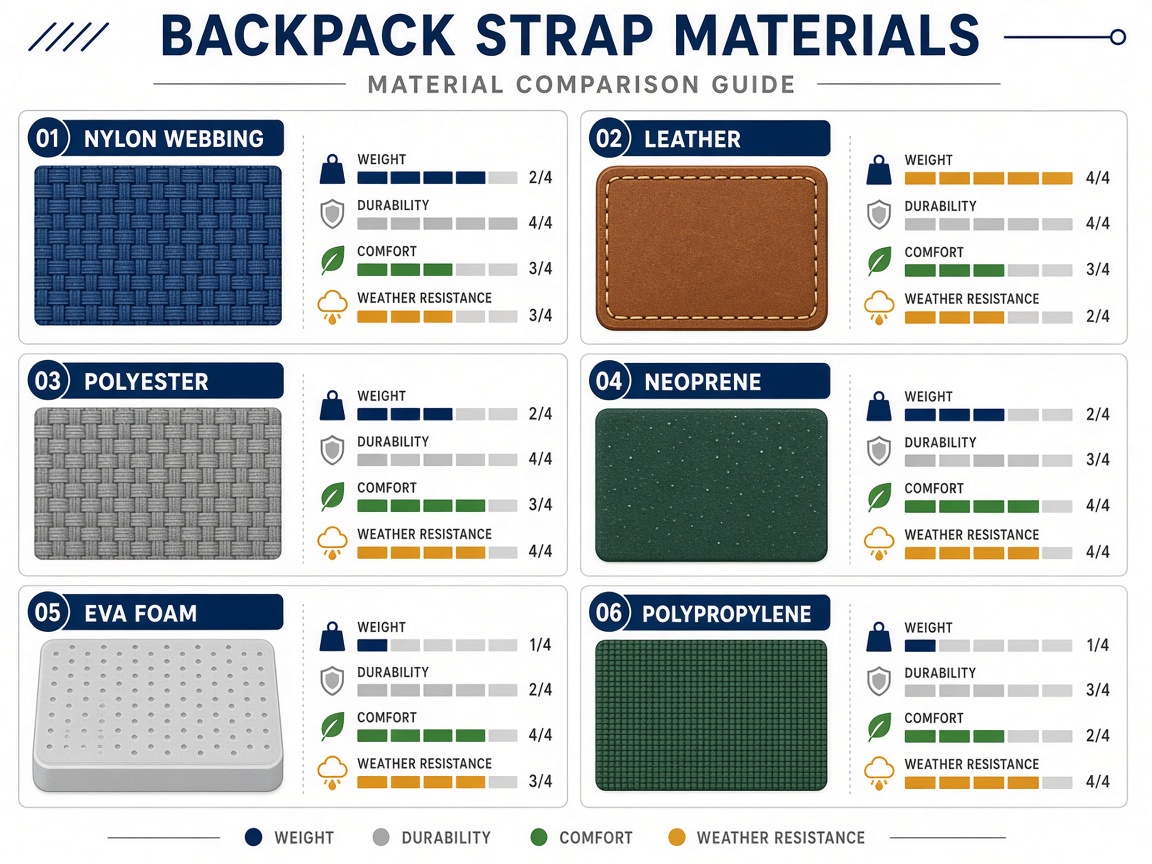
Here’s how the main strap and padding materials stack up across the factors that matter most for everyday and outdoor use:
| Material | Weight | Durability | Comfort | Weather Resistance | Best For |
|---|---|---|---|---|---|
| Nylon webbing | Light | Very high | Medium (needs padding) | Excellent | Hiking, travel, commuting |
| Leather | Heavy | High (with care) | Good (stiff initially) | Poor when wet | Urban and fashion packs |
| Polyester webbing | Light | High | Medium | Good | Everyday and budget packs |
| Neoprene (padding) | Medium | Medium | Very high | Good | Long daily carries |
| EVA foam (padding) | Very light | High | High | Excellent | Hiking and technical packs |
| Polypropylene | Very light | Medium | Medium | Good | Budget and light-use packs |
What Eco-Friendly Strap Materials Are Available?
Sustainability is increasingly part of the conversation in backpack design, and strap materials are no exception. Several manufacturers now offer packs with straps made from more environmentally considered alternatives to virgin synthetic materials — and the range is growing heading into 2027 and beyond.
- Recycled polyester: Made from reclaimed plastic bottles or post-consumer textile waste. It performs comparably to virgin polyester in strap applications and diverts plastic from landfill or ocean disposal. It’s currently the most practically available eco-friendly strap option on the mainstream market.
- Organic cotton: Grown without synthetic pesticides or genetically modified seeds. Cotton straps are soft and breathable — well-suited to indoor or low-intensity use — but absorb water readily, which makes them less practical in wet outdoor conditions.
- Hemp: A fast-growing crop that requires relatively little water or pesticide input. Hemp fibre produces a strong, durable webbing well-suited to strap applications. It remains a niche choice in mainstream manufacturing, but specialist sustainable pack makers use it and production is expanding.
- Bamboo fabric: Bamboo is a rapidly renewable resource. The resulting fabric is soft with decent moisture-wicking properties. It’s more commonly found in strap liners and padding covers than in structural webbing, given the demands placed on the load-bearing layer.
If sustainability matters to your buying decision, it’s worth verifying manufacturer certifications directly — claims vary considerably in how rigorously they’re backed up and independently audited.
How Do You Choose the Right Strap Material for Your Needs?
The best strap material depends on how you use the pack, how much you carry, and how long you wear it at a stretch. Work through these steps to narrow down what matters for your situation:
- Identify your load weight. Lighter loads (under 8 kg) are well served by most strap materials. Heavier loads benefit from nylon webbing and contoured EVA or neoprene padding to prevent pressure concentration on the shoulder.
- Consider how long you’ll wear it. Wearing a pack for 20 minutes is very different from wearing it for eight hours on a trail. Longer carries make padding material — particularly neoprene or contoured EVA — worth the added cost and weight.
- Think about your environment. Wet conditions favour nylon and EVA (both quick-drying and moisture-resistant) over leather or cotton. Hot climates make breathability a priority — mesh-backed panels or ventilated strap designs help significantly here.
- Factor in aesthetics. For fashion-forward city packs, leather or faux-leather straps may fit the brief perfectly — just go in knowing the maintenance requirements and limitations in wet weather.
- Get the torso fit right before buying. No strap material will feel comfortable if the pack doesn’t fit your torso correctly. Measuring your torso length before buying ensures the straps sit in the right position on your shoulders and back — that’s half the comfort equation.
- Adjust properly once you have the pack. Even the best strap material performs poorly if the straps aren’t correctly fitted to your body. Proper adjustment is as important as the material itself, especially with heavier loads.
If your existing pack’s straps are causing discomfort, the issue may be fit rather than material. Many packs offer more adjustability than owners realise, and adjusting strap length for a better carry position can resolve common discomfort without buying a new bag.
Frequently Asked Questions
What is nylon webbing in backpack straps?
Nylon webbing is a tightly woven flat strip of nylon fibre used as the structural element of most backpack straps. It’s strong, lightweight, quick-drying, and adjustable — which is why it’s the standard material in hiking, travel, and outdoor packs. It’s usually paired with a separate padding layer (foam or neoprene) for comfort, since bare webbing alone concentrates pressure on the shoulder under heavy loads.
Are leather backpack straps durable?
Yes, leather straps are durable when properly maintained. They resist surface abrasion well and can last many years if conditioned regularly with a leather balm or oil. The main vulnerability is moisture — repeated wetting without conditioning causes leather to stiffen and eventually crack. For packs used regularly in wet or outdoor environments, nylon is typically a more practical long-term choice.
What is the most comfortable padding material for backpack straps?
Neoprene and contoured EVA foam are both regarded as strong performers for shoulder strap comfort. Neoprene is soft and molds to your shoulder shape over time; EVA foam is lighter and holds its contoured shape well without absorbing moisture. For extended carries with heavier loads, contoured straps built over an EVA foam core tend to distribute load most effectively across the shoulder.
Is polyester or nylon better for backpack straps?
Nylon is generally stronger, more abrasion-resistant, and quicker-drying than polyester — which makes it the preferred choice in performance and outdoor packs. Polyester costs less to produce, so it’s common in everyday and budget packs where the performance differences matter less in practice. As an outer panel fabric over foam padding, polyester is a perfectly good choice for most use cases.
Can backpack strap material be replaced?
It depends on the pack’s construction. Many technical hiking packs have shoulder straps that can be unclipped and replaced — either with manufacturer-supplied parts or aftermarket options. On sewn-in straps, replacement requires sewing, either by a repair shop or at home. If a buckle rather than the strap material itself has failed, that’s a considerably easier repair — and replacing a broken backpack buckle is something most people can handle without specialist tools.
What are the most eco-friendly backpack strap materials?
Recycled polyester, hemp, and organic cotton are the most commonly used eco-friendly options. Recycled polyester performs comparably to virgin polyester in strap applications while diverting plastic waste from landfill or ocean disposal. Hemp produces strong, durable webbing with relatively low agricultural inputs. Organic cotton is soft and breathable but absorbs moisture, making it better suited to lighter, drier use cases rather than wet outdoor conditions.
How do I know if my backpack straps are padded enough?
If you notice pressure or discomfort concentrated on one part of your shoulder after 30–60 minutes of carrying, the padding is likely insufficient for your load. Well-padded straps spread that pressure across the full shoulder contact area. Contoured straps with EVA or neoprene padding usually outperform flat foam straps for heavier or longer carries. If you regularly carry loads above 8 kg, adequate padding becomes much more important to get right.
Final Thoughts
Strap material might not be the first thing on your checklist when buying a backpack, but it should be near the top. Nylon webbing with EVA or neoprene padding covers the majority of use cases well — durable, weather-resistant, and comfortable under real load. Leather suits city packs where weight and weather exposure are less of a concern. Polyester webbing and polypropylene are perfectly viable for lighter, everyday use where performance demands are modest.
The smartest approach is to match the material to the job: how much weight, how long a carry, and what environment. Get that right, measure your torso before you buy, and adjust the straps properly once you have the pack — and you’ll carry more comfortably than the vast majority of backpackers, regardless of which bag you end up with.