Your polyester backpack can look and smell brand new again in under an hour. Mild detergent, cold water, targeted stain treatment, and a coat of fabric protection spray are all it takes to strip away deep-set grime, neutralise persistent odours, and restore water-resistance — without damaging the material or shortening its lifespan.
Key Takeaways
- Clean every 2–3 months under normal use, or monthly if you take your pack into the outdoors regularly — irregular cleaning allows bacteria and embedded grit to degrade fibres from the inside out.
- Always use cold water and a mild, non-bio detergent — standard household detergent contains enzymes and optical brighteners that strip DWR coatings and weaken polyester fibres over time.
- Air drying is non-negotiable. A tumble dryer — even on low heat — warps zippers, melts seam adhesive, and permanently destroys protective coatings.
- Re-proof with a DWR spray after every wash to restore weather-resistance.
Why Does Your Polyester Backpack Need Regular Revitalising?
Polyester is one of the world’s most widely used technical fabrics — it’s the material of choice for most quality backpacks precisely because it’s tough, lightweight, and resistant to stretching. But durability is not the same as maintenance-free, and the two are frequently confused.
Every trip adds a new layer of invisible damage. Skin oils, sweat residue, food particles, and trail grit accumulate on and inside the fabric with every use. Frequently-used bags accumulate bacteria on their interior lining after just a few months of regular use — and it’s those bacteria that produce the stale, musty smell most backpack owners eventually recognise. By then, the problem has already progressed well beyond the surface.
The invisible damage is actually the more serious problem. Dirt particles work their way deep into polyester weaves and act like microscopic sandpaper. Every time the bag flexes, those embedded particles abrade the fibres from within. Over time, this mechanical action weakens stitching at stress points, dulls the fabric’s colour, and — critically — destroys the durable water repellent (DWR) coating that keeps your contents dry in wet conditions.
The financial case for regular cleaning is straightforward. A quality replacement polyester backpack typically costs between $80 and $200. A full revitalisation costs under $10 in supplies and under an hour of time. Whether you’re keeping your pack in shape for daily commutes or getting it ready for a weekend in the hills — our guide on how to pack a backpack for hiking covers what goes inside once your bag is clean — proper maintenance is clearly the smarter option at every price point.
What Cleaning Supplies Do You Need Before You Start?
Having the right supplies ready before you start prevents the single most common cleaning mistake: reaching for whatever’s under the sink. Standard household detergents, bleach-based cleaners, and general-purpose sprays can do more harm to your pack than the dirt they’re supposed to remove. Most standard detergents contain optical brighteners and enzymes that actively degrade DWR coatings on the first wash.
Here’s what you actually need to do this properly:
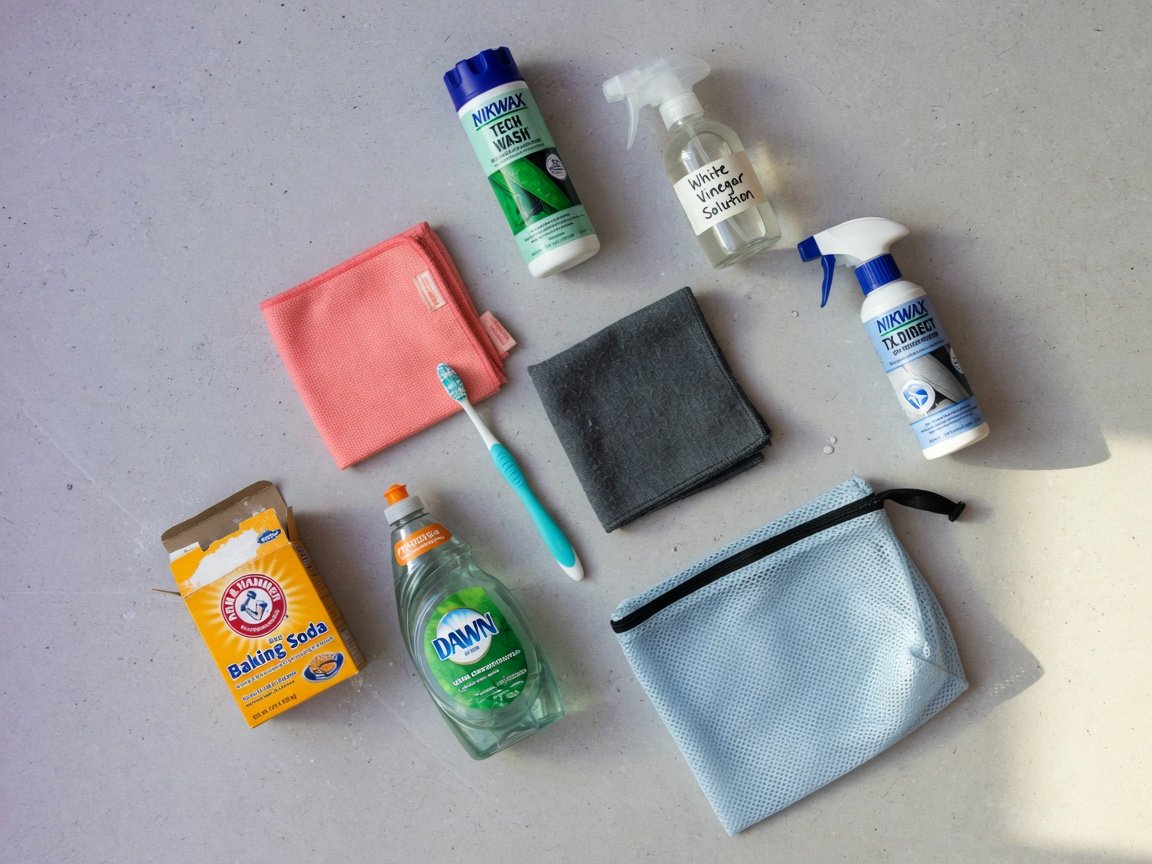
- A mild, fragrance-free liquid detergent — or a specialist outdoor gear wash such as Nikwax Tech Wash
- A soft-bristled brush or spare toothbrush for scrubbing seams and pocket corners
- Several clean microfibre cloths
- A vacuum cleaner with a narrow nozzle attachment
- Rubbing alcohol / isopropyl alcohol (for ink and ballpoint pen stains)
- Washing-up liquid or dish soap (for grease and oil stains)
- Baking soda (for odour neutralisation)
- White vinegar (for mildew and persistent musty smells)
- A DWR fabric protection re-proofer spray (applied after washing)
- A mesh laundry bag (if machine washing)
- Zipper lubricant or beeswax (for zipper maintenance at the end)
Most of these items are low-cost and widely available. The investment in a specialist outdoor wash — typically $10–$15 per bottle — pays for itself immediately by preserving a DWR coating that would cost $20–$40 to replace as a separate product. Assembling everything upfront also means you won’t interrupt the cleaning process mid-step when something is missing.
How Do You Inspect and Prepare Your Backpack Before Cleaning?
Ten minutes of preparation before washing prevents most cleaning disasters. Gear care specialists consistently report that skipping the inspection stage is the leading reason backpacks come out of washes with new damage — split seams, rusted hardware, or missing components that were spun through a wash cycle they never should have seen.
- Empty every pocket and compartment completely. Check media sleeves, key clips, and hidden organiser pockets. Coins, pens, and earbuds left inside can damage the pack’s lining and the washing machine drum.
- Shake the pack out over a bin. This removes the majority of loose crumbs, trail debris, and dust in seconds and makes the vacuum step much faster.
- Vacuum all interior compartments thoroughly. Use a nozzle attachment to clear corners, pocket seams, and any mesh dividers. This step is especially important if the pack has been used for hiking, travel, or beach trips where grit accumulates.
- Inspect for existing damage. Check stitching at high-stress points: shoulder strap attachment, hip belt anchor, and main zip corners. Washing a pack with a compromised seam can cause it to split entirely.
- Remove all detachable components. This includes aluminium stays, foam hip belt pads, sleeping bag straps, carabiners, and any external hardware. Metal components can rust, tarnish, or puncture the fabric interior during a wash cycle.
- Open all zippers and loosen all buckles. Closed zippers under wash-cycle stress can develop cracks in the teeth or slider mechanism. Open is always better.
- Read the manufacturer’s care label. This is the definitive guide to approved washing temperatures and methods. If the label is missing or faded, default to cold-water hand washing — always the safer choice.
How Do You Remove Stubborn Stains from Polyester?
Polyester is naturally more stain-resistant than cotton or nylon, but certain marks — oil-based stains, ink, dried coffee, and mildew — require targeted pre-treatment before the main wash. Attempting to remove them in a general wash without pre-treatment first almost always results in the stain heat-setting permanently into the fibres, particularly during machine washing.
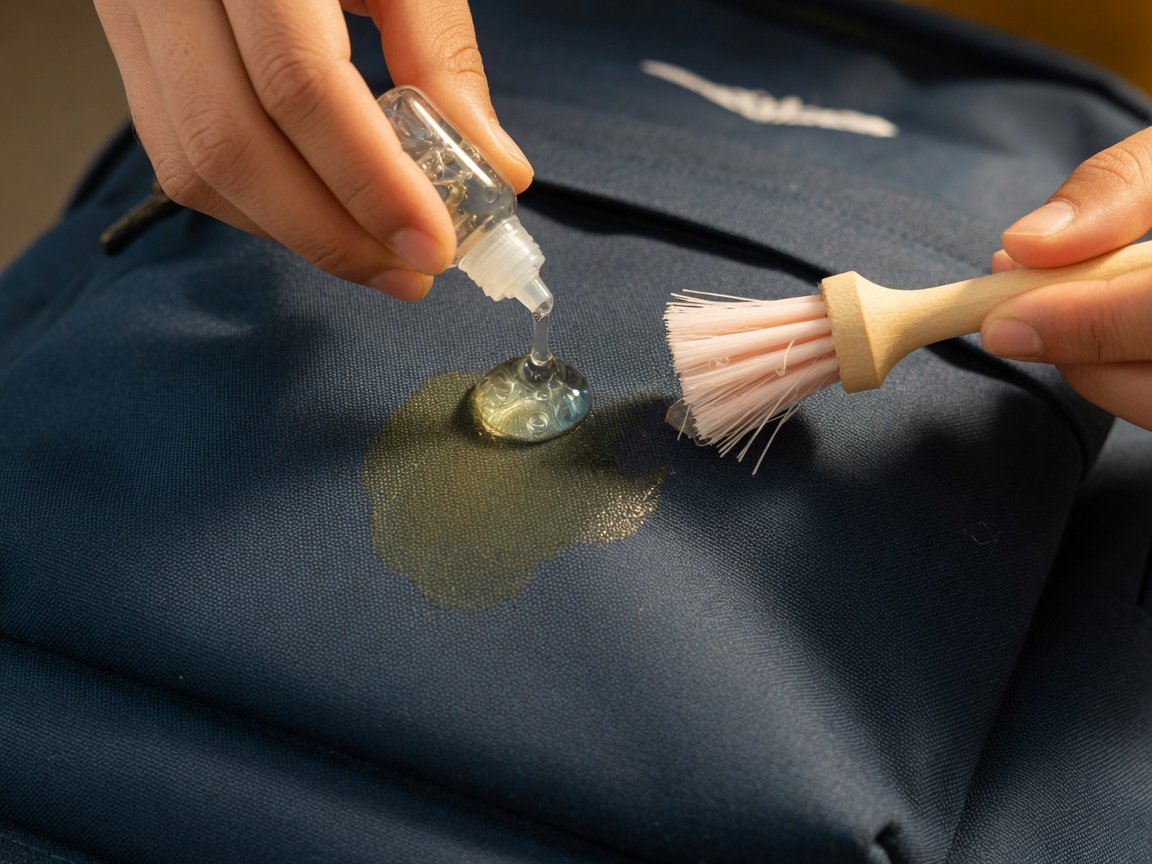
| Stain Type | Treatment Method | Critical Rule |
|---|---|---|
| Coffee / tea | Blot with cold water and mild dish soap. Leave 5 minutes, then gently scrub in circular motions with a soft brush. | Always blot — never rub |
| Ink / ballpoint pen | Dab rubbing alcohol onto a cotton ball and apply to the stain without any rubbing motion. | Dabbing only — rubbing spreads the ink laterally |
| Grease / oil | Apply a pea-sized amount of dish soap directly to the stain. Leave 10–15 minutes to break down oils, then rinse with cold water. | Don’t rinse before the soap has had time to work |
| Mud / trail dirt | Let dry completely. Scrape off residue with a blunt tool, then brush clean before washing. | Never treat wet mud — it spreads deeper into the weave |
| Mildew | Apply a 1:1 white vinegar and cold water solution. Leave 20 minutes, then scrub gently. Rinse thoroughly. | Rinse completely — vinegar residue weakens polyester fibres over time |
| Around reflective strips | Hand dab only with a damp cloth and mild soap — no prolonged soaking near reflective surfaces. | Avoid rubbing alcohol near reflective material — it can dissolve the bonding adhesive |
Forceful scrubbing pushes stain particles deeper into the fibre structure and can permanently distort the surface texture — patience and a gentle technique will almost always produce a better result than speed and pressure.
One practical rule worth remembering: always pre-treat stains before the full wash, never after. A general wash cycle can lock a stain into the fibres if it hasn’t been broken down first — making removal significantly harder or, in some cases, impossible. Pre-treat first, confirm the stain has lifted, then proceed to the full wash.
Should You Machine Wash or Hand Wash Your Polyester Backpack?
Both washing methods work well for polyester — the right choice depends on your specific pack’s construction and what the care label approves. A standard polyester daypack without metal stays or electronic integration will typically handle a machine wash without issue. A technical hiking pack with structured framing, reflective piping, hydration ports, or bonded seam tapes warrants more careful hand washing where you control every variable.
| Factor | Machine Wash | Hand Wash |
|---|---|---|
| Best for | Standard daypacks, school bags, travel packs | Technical hiking packs, structured frames, reflective strips, electronics pockets |
| Water temperature | Cold only — 30°C maximum | Cold to cool — no warmer than 30°C |
| Cycle / method | Delicate or gentle cycle — no spin above 800 RPM | Soft brush and sponge in a basin or bathtub |
| Detergent | Mild, non-bio — no bleach, no fabric softener | Mild, non-bio — diluted in water first |
| Mesh laundry bag | Required — protects hardware and machine drum | Not needed |
| Control over sensitive areas | Low | High |
| Time | 45–60 minutes (wash cycle duration) | 20–30 minutes active scrubbing |
| DWR coating impact | Higher — use specialist detergent to minimise | Lower — more controlled application |
For machine washing: place the emptied, unzipped pack inside a mesh laundry bag. Select the delicate or gentle cycle, cold water, and add the correct amount of mild detergent or specialist gear wash. Skip fabric softener entirely. Do not use spin cycles above 800 RPM — high spin forces stress zippers and all sewn attachment points. For hand washing, fill a clean bathtub or large basin with cold water and a small amount of diluted detergent, then use a soft brush to work through all surfaces, paying particular attention to shoulder straps, the back panel, and the main zip seam.
For a detailed, step-by-step breakdown of both washing methods — including tips for handling specific pack features — the complete backpack washing guide at The Backpack Expert covers every stage in detail. Rinse the pack at least twice after washing; detergent residue left in the fabric attracts more dirt and can cause strap irritation on skin contact.
How Do You Safely Dry a Polyester Backpack After Washing?
Drying is where the most irreversible damage happens — and it’s almost entirely avoidable with the right approach. Heat is polyester’s primary structural enemy. A tumble dryer, even on the lowest heat setting, can warp zippers, melt the adhesive bonding internal seam tapes, shrink shoulder strap foam inserts, and permanently destroy DWR coatings. Heat exposure is a leading cause of premature backpack failure — damaging zippers, seam tapes, foam padding, and protective coatings.
- After washing, gently shake out excess water. Do not wring or twist — this strains seam stitching at exactly the points most likely to fail first.
- Hang the pack upside down from a hook, towel rail, or clothes airer in a well-ventilated indoor space — a utility room or airy hallway works well.
- Loosely stuff the main compartment with clean, dry towels. This helps the pack retain its shape while the interior lining dries and absorbs residual moisture from the inside.
- Open all zippers and all external pockets so interior air can circulate freely throughout the drying period.
- Leave for a minimum of 24 hours. Larger packs with padded hip belts or thick foam back panels may need the full 48 hours to dry completely through the padding.
- Keep the pack away from direct sunlight throughout drying. UV exposure fades colours, slowly degrades polyester fibres, and shortens the life of both the fabric and any printed logos or graphics.
If you need to speed up the process, positioning a fan nearby to improve airflow is perfectly fine — just no heat source of any kind. Never place a damp pack in a sealed wardrobe or roll it up before it’s fully dry. Moisture trapped in a closed space is precisely the environment mildew needs to take hold, and a mildew problem that becomes established is far harder to resolve than one prevented entirely.
How Do You Eliminate Odours from a Polyester Backpack?
Persistent odour after washing is one of the most common frustrations in backpack care — and it’s almost always a sign that the odour source wasn’t treated before washing. A standard wash cycle dilutes and reduces bacterial load, but it doesn’t always eliminate it entirely, particularly when bacteria have embedded themselves into the foam padding of back panels and shoulder straps. Absorbed organic material from sweat, food, and body oils adds another layer that general washing doesn’t fully address.
For stubborn odours that survive a full wash, work through these targeted approaches in order of severity:
- Baking soda treatment: Sprinkle a generous amount of baking soda into all interior compartments. Leave overnight — or 48 hours for severe cases. Vacuum out thoroughly before the main wash. Baking soda is a mild alkaline compound that neutralises both acidic and organic odour compounds without leaving a chemical residue.
- White vinegar spray: Mix equal parts white vinegar and cold water in a spray bottle. Lightly mist the interior lining and all fabric compartments. Leave all zippers open and allow to air dry completely. The vinegar smell dissipates within a few hours as it evaporates, taking most other odours with it.
- Activated charcoal sachets: Place sachets inside the closed pack for 24–48 hours. Particularly effective at absorbing stubborn chemical smells, gym bag odour, and persistent food aromas that vinegar and baking soda don’t fully address.
- Enzyme-based cleaner: For deeply organic odours — sweat, pet contact, or food spills that have soaked into the foam padding — enzyme cleaners break down odour-producing compounds at the molecular level. Apply, observe the recommended dwell time, then rinse thoroughly and allow to dry fully before use.
If your pack includes a hydration reservoir or water bladder, that component is very often the actual source of persistent musty odours — and it requires completely separate treatment from the pack itself. The full guide to revitalising your backpack water bladder walks through cleaning the reservoir, drinking tube, and bite valve, all of which are prone to biofilm and mould growth if not maintained independently of the main pack.
What Fabric Protection Steps Keep Your Backpack Weather-Ready?
A clean polyester backpack is still vulnerable to water ingress if its protective coating has degraded. Even careful washing with a gentle detergent gradually reduces the effectiveness of the DWR coating applied to most outdoor fabrics at the point of manufacture. DWR coatings on packs that aren’t re-proofed after washing degrade with repeated washing, and for packs washed frequently this can be significant within a single year of regular use.
The solution is fast, inexpensive, and genuinely effective. A quality DWR re-proofer spray applied correctly after each wash restores the microscopic water-repellent layer on the outer fabric surface.
How to re-proof your polyester backpack properly:
- Ensure the pack is completely clean and slightly damp — not soaking wet, but not bone dry either. The slightly damp surface allows the DWR spray to bond and spread more evenly across the fabric.
- Lay the pack on a flat surface or hang it up. Apply the DWR spray in even, overlapping passes from approximately 15–20cm distance, covering the entire outer surface including the base panel, straps, lid, and all external pockets.
- Allow the coating to penetrate and bond for 20 minutes without disturbance.
- For best results, lightly heat-activate the coating. This can be done by running a warm (never hot) iron over the fabric through a thin pressing cloth, or by placing the pack in a tumble dryer on the absolute lowest heat setting for 20 minutes — only if the care label explicitly permits any heat drying.
- Allow to cool fully before storing or using the pack.
This step becomes even more important for packs used in marine or coastal environments, where salt air and persistent humidity accelerate coating breakdown significantly faster than inland use. The specific care requirements for packs that face these conditions are covered in depth in our guide to extending your beach backpack’s life — the environmental stressors at the coast are meaningfully more demanding than standard outdoor use.
What Maintenance Habits Actually Add Years to Your Backpack’s Life?
A single revitalisation restores your pack. Consistent habits are what keep it performing at that level for years. Backpacks that receive routine maintenance last significantly longer than identical packs that receive only occasional cleaning — a difference that translates directly to both cost savings and consistent performance in the field.
- Spot clean after every trip. A 30-second wipe with a damp microfibre cloth after each use prevents most stains from setting and removes surface grit before it embeds into the weave.
- Empty and air out after every use. Never put a damp or dirty pack into a cupboard. The combination of trapped moisture and residual bacteria in an enclosed space accelerates mildew growth faster than almost any other factor.
- Lubricate zippers every 2–3 months with a specialist zipper lubricant or beeswax. Stiff zippers are the most common single point of failure in an otherwise healthy pack, and they’re entirely preventable.
- Never overload beyond the manufacturer’s rated capacity. Consistently overloading stresses stitching at attachment points on every trip, regardless of how well you clean the pack between uses.
- Store loosely in a cool, dry, dark location. Compressing or folding the pack in storage creates permanent crease lines and puts sustained stress on buckles and clip points.
- Re-proof at least annually — more frequently if the pack is used outdoors in wet conditions regularly throughout the year.
For a deeper look at how each of these habits compounds across a pack’s working life — and why small investments in care deliver such outsized returns on lifespan — the 10 expert tips for extending your backpack’s lifespan covers the full picture with specifics for different pack types and use intensities.
Polyester rewards consistent care in ways that many synthetic alternatives don’t — it is remarkably forgiving when properly looked after, and remarkably unforgiving when it isn’t.
What Cleaning Mistakes Are Silently Ruining Your Polyester Backpack?
Knowing what not to do is just as important as the cleaning steps themselves. These six mistakes are extremely common — and each one compounds quietly over time, reducing your backpack’s functional lifespan well before it should ever need replacement.
Using Bleach or Harsh Chemical Cleaners
Bleach destroys DWR coatings on contact, weakens polyester fibres at the molecular level, and causes irreversible colour fading and fabric brittleness. Even heavily diluted bleach-based cleaners should never be used on polyester packs. The same applies to solvent-based stain removers and general-purpose household sprays not specifically formulated for technical fabrics.
Washing with Hot Water
Hot water causes polyester to shrink and warp and dramatically accelerates DWR degradation. Cold water — a maximum of 30°C — is non-negotiable for both machine and hand washing.
Skipping the Mesh Laundry Bag for Machine Washes
Washing an open pack in a machine without a mesh laundry bag exposes buckles, metal loops, and compression clips to direct contact with the rotating drum. They snag interior fabric surfaces, scratch the drum, and subject the pack’s hardware to rotational forces it was never designed to withstand. Always use a mesh laundry bag — it’s a $5 purchase that prevents $100 worth of damage.
Using Fabric Softener
Fabric softeners coat textile fibres with a hydrophilic (water-attracting) compound — the precise opposite of what a DWR-treated backpack requires for weatherproofing. They also reduce the breathability of mesh back panels and ventilation channels, which matters considerably for comfort on longer hikes. Avoid fabric softeners in any form when washing any outdoor gear.
Storing the Pack Before It’s Fully Dry
Putting a pack away before it has dried completely is the fastest route to a mildew infestation that even repeated washing won’t fully resolve once established. If you’re uncertain whether the pack is dry, leave it an additional 12 hours with all zippers open in a ventilated space. Certainty is worth the extra wait time — always.
Ironing Directly on Polyester
Direct iron-to-fabric contact will melt polyester fabric, even at settings marketed as “low.” If you need to smooth post-wash creases, always use a thin pressing cloth between the iron and the fabric, keep the heat at its absolute minimum setting, and keep the iron moving constantly. In practice, most creases in a polyester pack relax naturally as it air dries over its shape — ironing is rarely necessary and should be a last resort.
Polyester is highly resilient under normal use conditions but has well-documented vulnerabilities to heat and certain chemical solvents. Systematically avoiding those during cleaning is what keeps a polyester pack performing reliably for years.
Frequently Asked Questions: Cleaning and Caring for Polyester Backpacks
Can I use fabric softener on my polyester backpack?
No — and this is one of the more important rules in polyester pack care. Fabric softener deposits a hydrophilic (water-attracting) coating on fabric fibres that actively works against the DWR water-repellent treatment most outdoor packs carry. It also reduces breathability in mesh panels and tends to leave a residue that attracts more dirt between washes. Use a mild, fragrance-free detergent or a specialist outdoor gear wash instead — those are formulated specifically to clean without compromising the fabric’s technical performance.
How often should I clean my polyester backpack?
For everyday use — commuting, school, light travel — a full clean every 2–3 months is a reasonable baseline. For packs used on outdoor adventures such as hiking, camping, or trail running, monthly cleaning better reflects the level of exposure the pack accumulates. Between full washes, spot cleaning after each trip prevents stains from setting and keeps bacterial buildup from reaching the levels that create persistent odour problems.
Will washing my backpack damage its reflective strips?
Machine washing can damage reflective elements if done carelessly. Reflective strips use a micro-bead or prismatic foil surface that’s vulnerable to physical abrasion from drum contact and to the adhesive being weakened by prolonged soaking. If your pack has significant reflective material — particularly on shoulder straps or the main panel — hand washing is the safer choice. Use a soft cloth rather than a brush near the strips, avoid prolonged submersion, and never apply rubbing alcohol near reflective surfaces, as it can dissolve the bonding adhesive.
Can I iron my polyester backpack after cleaning to remove creases?
Direct iron-to-polyester contact melts the fabric even on low heat settings — this is a property of the material rather than a calibration issue with your iron. If you do need to address creases, place a thin pressing cloth between the iron and the fabric, use the absolute lowest heat setting, and keep the iron in constant motion. In most cases, post-wash creases in polyester packs relax naturally as the pack air dries over 24–48 hours and regains its shape from within — making ironing unnecessary in the vast majority of situations.
Is it safe to use disinfectant spray on a polyester backpack?
Most spray disinfectants are safe for occasional spot application on polyester fabrics, but they’re not a substitute for proper washing and shouldn’t be used routinely. Disinfectants can leave a residue that dulls the fabric surface, and with repeated application may affect DWR coatings. If you use one — for instance, after a medical setting visit or gym use — wipe the treated area with a damp cloth afterwards to remove residual product. Always test on a small, inconspicuous area first to check for any unexpected colour reaction.
Can I put my polyester backpack in the tumble dryer?
In almost all cases, no. Tumble dryer heat — even on the lowest setting — warps zippers, melts seam tape adhesive, shrinks foam shoulder padding, and destroys DWR coatings. The only exception is if your care label explicitly approves tumble drying on a no-heat or very-low-heat setting — and even then, only for a brief period (20 minutes maximum) after the pack has already been nearly fully air dried. Air drying is always the safer, correct default for any polyester backpack.
How do I remove mould from a polyester backpack?
Start by taking the pack outside and brushing off any visible mould growth with a dry brush — you want to avoid spreading spores around indoors. Then treat the affected area with a 1:1 solution of white vinegar and cold water. Leave for 20–30 minutes, then scrub gently with a soft brush. Follow immediately with a full hand wash using mild detergent. Air dry completely with all zippers open in a well-ventilated space. If the mould has penetrated deeply into foam padding or the interior lining, a second treatment cycle may be necessary — and if the infestation is extensive, the pack may need a professional assessment.
Your 2026 Polyester Backpack Revitalisation Plan: Where to Start Today
Revitalising your polyester backpack isn’t a one-off event — it’s a rhythm that pays compounding returns. The investment is genuinely minimal: under an hour, under $10 in supplies, and the right technique applied in the right order. The return is a pack that looks sharp, smells clean, stays weatherproof, and lasts years beyond what an ignored pack would manage.
Here’s a practical implementation sequence to make this immediately actionable:
- Today — 15 minutes: Empty the pack, inspect every seam and zipper for existing damage, and spot treat any visible stains using the targeted methods in this guide. Don’t wait for a “cleaning day” — pre-treating now prevents permanent setting.
- This weekend — 45–60 minutes: Full wash using whichever method your care label approves, followed by the 24–48 hour air dry cycle with all pockets open.
- After drying — 10 minutes: Apply DWR fabric protection re-proofer across the entire outer surface and condition all zippers with lubricant while the pack is still fresh.
- Ongoing habit — monthly or quarterly: Spot clean after trips, air out after every use, and address any new stains within 24 hours before they can set.
- Annually: Full revitalisation cycle — wash, odour treatment if needed, and a fresh DWR re-proof application.
A well-maintained polyester backpack will carry you through years of everyday use and adventure — commutes, trail runs, camping weekends, and international travel alike. That’s not just a cleaning guide; it’s a return on investment that shows up every single time you head out the door.
Treat your backpack as a piece of technical equipment rather than a disposable accessory. The same care principles that keep a tent or sleeping bag performing well for years apply here — a pack that’s properly maintained performs when you need it most, not just when it’s new.